3D and AR in e-commerce
Academic research
Role: Research, design, development
Presented at: Future Technologies Conference 2024 and the Irish Human Computer Interaction Symposium 2025, with Marian McDonnell and Denise McEvoy (IADT).
The problem
In a shop, you pick the thing up. You turn it over, feel the weight, check the material, and decide whether you trust it. Online, none of that is available, and you have to fall back on what you can imagine.
That is the gap this research looks at. Without sensory feedback, customers lean on mental imagery: how a product looks (spatial imagery) and how it feels (haptic imagery). The less clearly they can picture it, the less certain they are about what they're buying. Retailers have been betting that 3D models and AR can fill that gap. I wanted to know if they do.
Research questions
The study asked four questions, each with a matching hypothesis:
- Does presenting a product in 3D or AR change spatial or haptic imagery?
- Does it change user experience?
- Do spatial and haptic imagery affect product uncertainty?
- Is there a relationship between product uncertainty and user experience?
Most research on this had been done on desktop computers, which goes against how people actually browse. So the experiment was run on mobile, on participants' own phones.
Building something to test
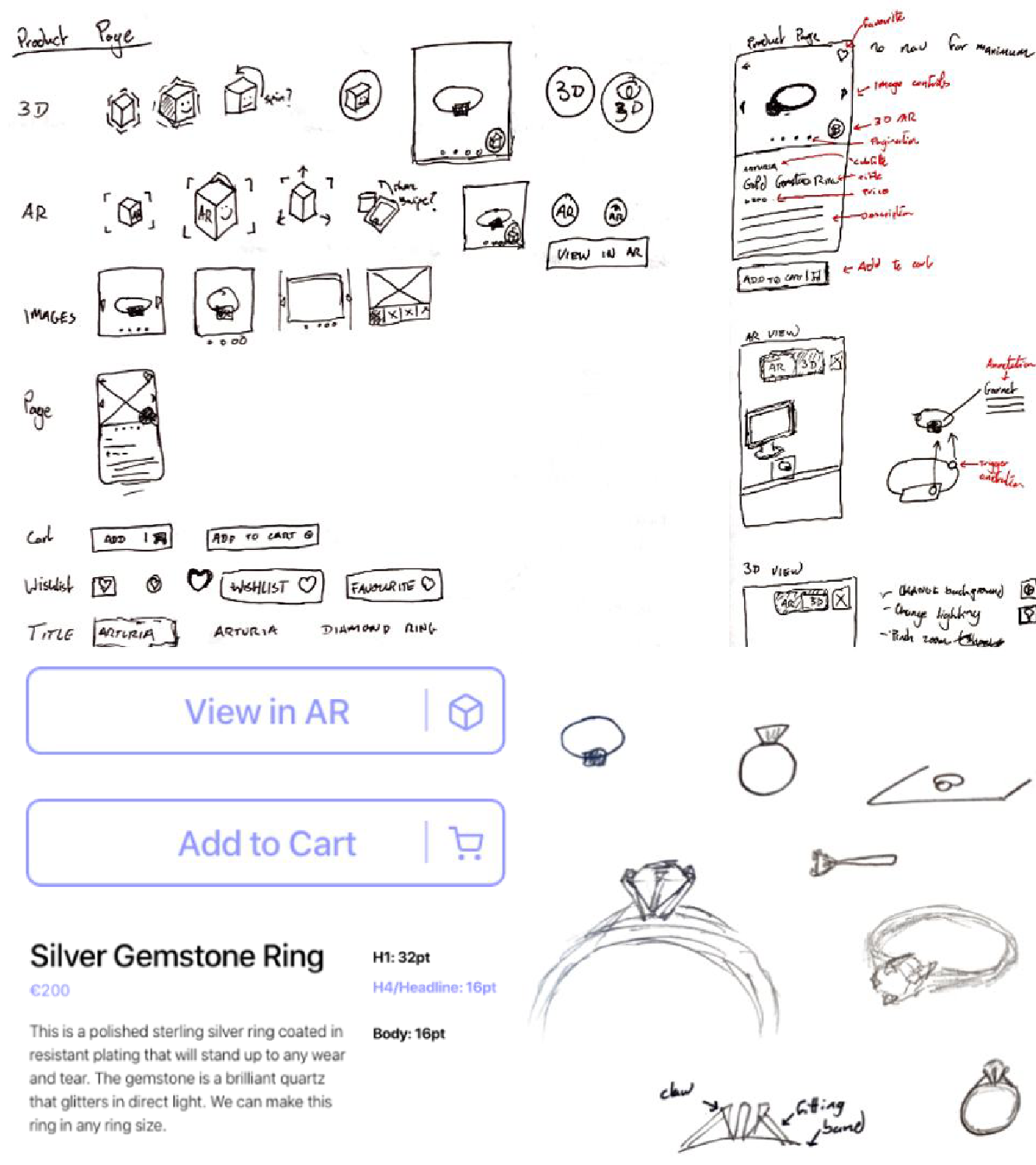
To keep the focus on product presentation, I designed and built an example e-commerce site with a deliberately unremarkable layout. Nothing in the store should stand out except the way the product was shown.
The product is a ring. It has both geometric and material qualities, which map neatly onto spatial and haptic imagery. I modelled it in Blender, then sketched and prototyped the product page with three variants: standard images (2D), an interactive 3D model, and AR through iOS AR Quick Look.
The experiment
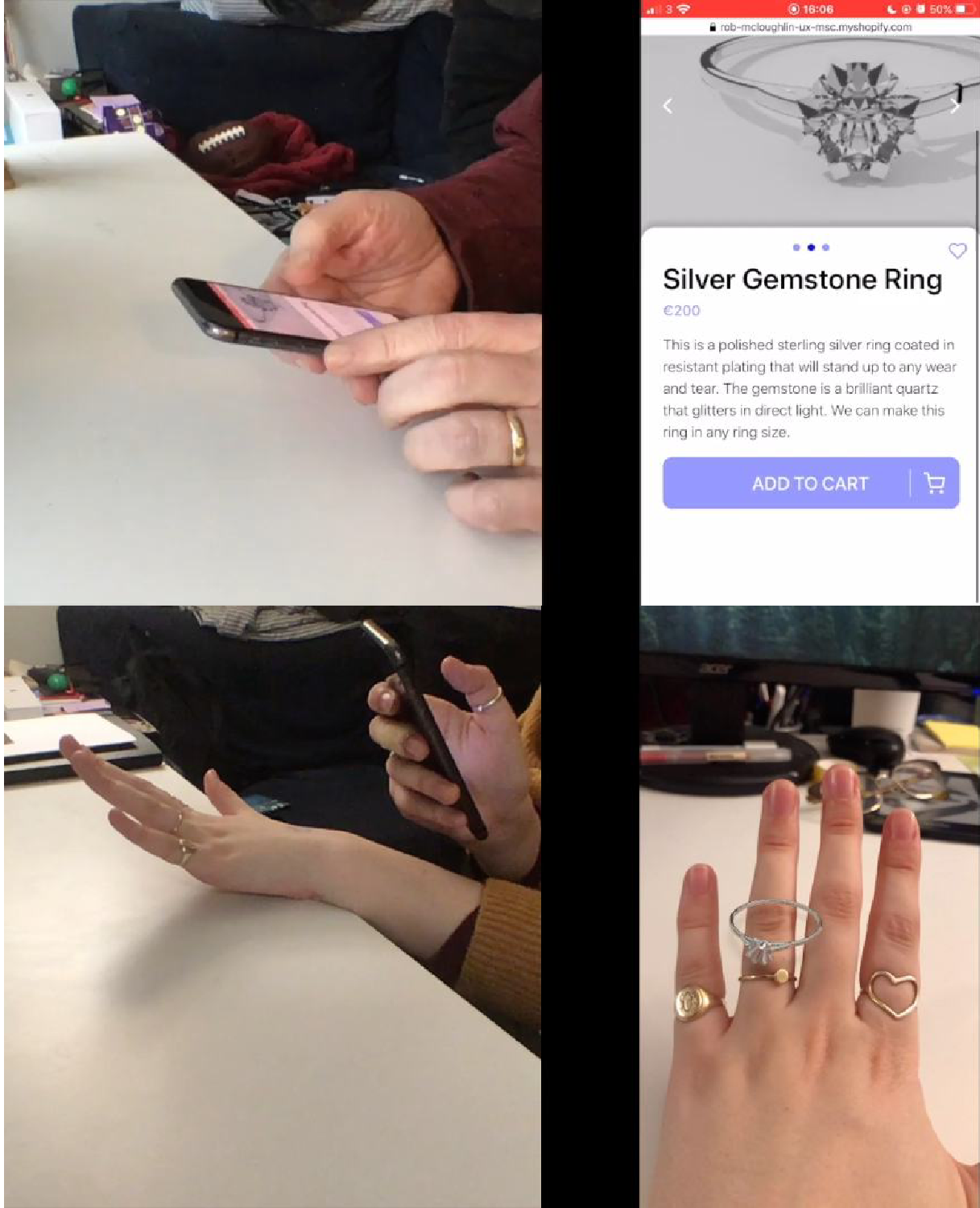
Thirty participants took part in a between-groups experiment. Each one saw only one version of the store: 2D, 3D or AR.
- Participants used their own device, and were randomly assigned to a group.
- Everyone was an iOS user, because the AR condition depends on AR Quick Look.
- They were asked to examine the product as if they were buying it for someone else.
- Afterwards they completed scales for spatial imagery, haptic imagery, product uncertainty, and user experience.
Imagery and uncertainty were measured with the scales from Liu, Jiang and Chan (2019). User experience used an abridged AttrakDiff, which splits into pragmatic quality (is it useful?) and hedonic quality (is it enjoyable?).
Results
Two of the four hypotheses were fully supported, one partly, and one not at all.
H1: Presentation does not change mental imagery. There was no significant difference in spatial or haptic imagery between the 2D, 3D and AR groups. Showing the product in 3D or AR did not make people picture it any better.
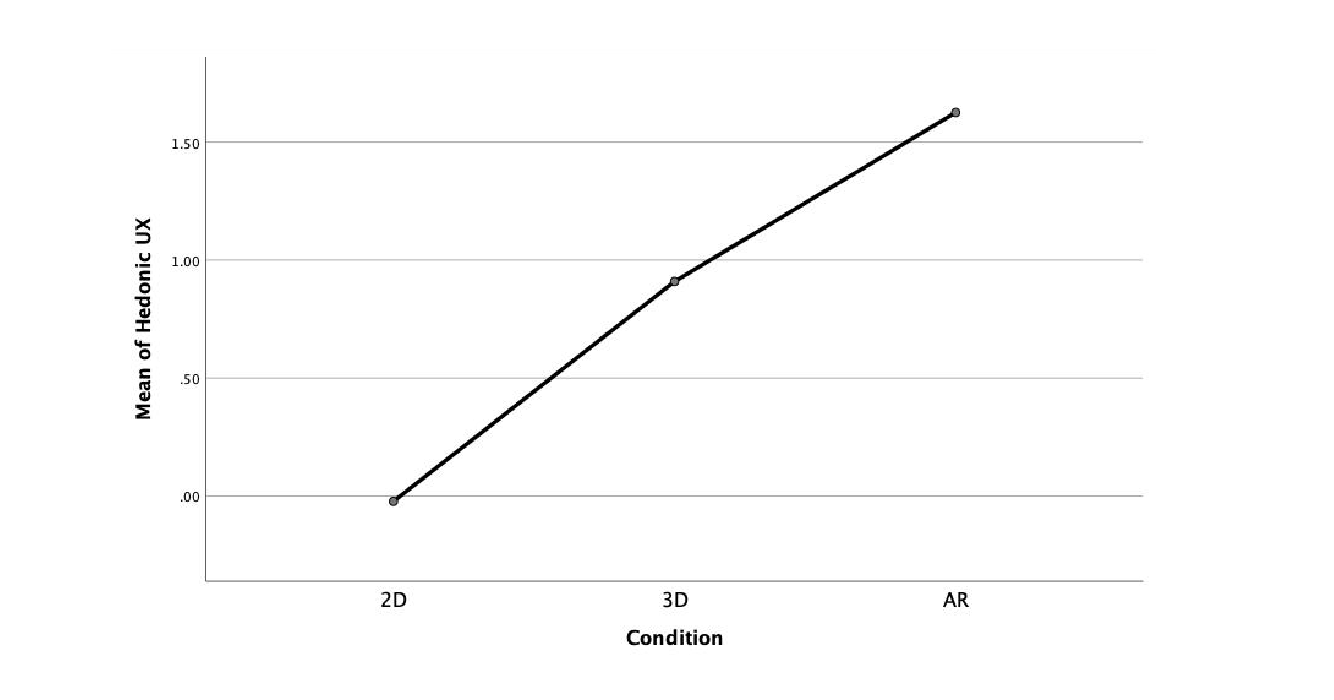
H2: AR improves how enjoyable it is, not how useful. Hedonic UX differed by presentation type. The 2D group (M = -0.23, SD = 1.49) was significantly different from the AR group (M = 1.63, SD = 1.00). The 3D group sat in between and did not differ significantly from either. The effect size was 0.26, a small effect. Pragmatic UX did not differ at all.
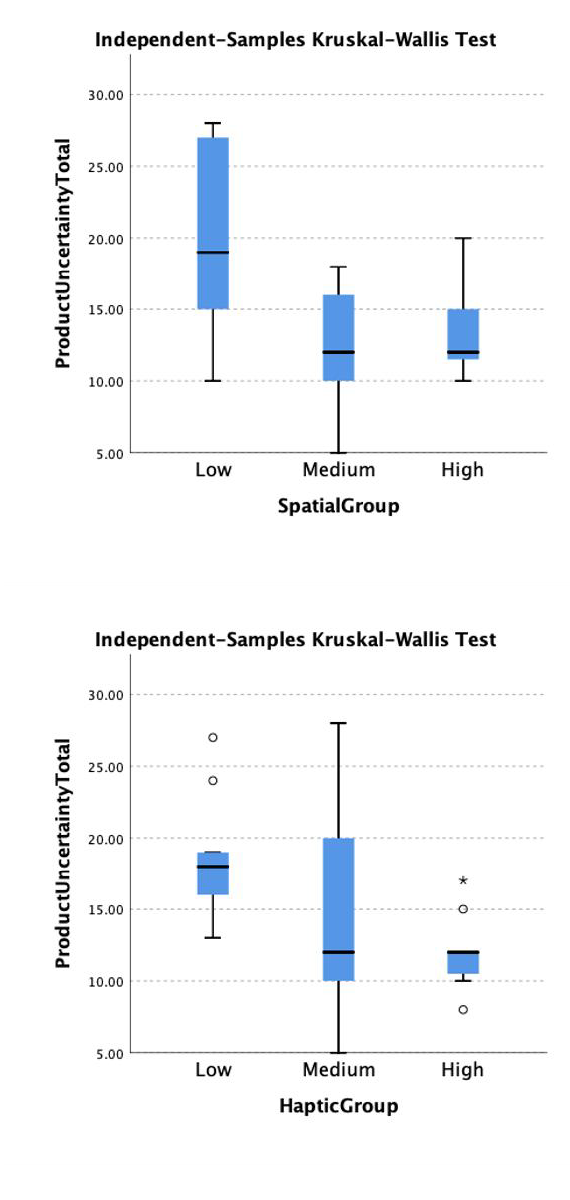
H3: Imagery does reduce uncertainty. Users with low spatial imagery were far more uncertain (M = 19.90, SD = 6.79) than those with medium spatial imagery (M = 12.15, SD = 4.16). The same held for haptic imagery: low (M = 18.44, SD = 4.45) against high (M = 11.82, SD = 2.44).
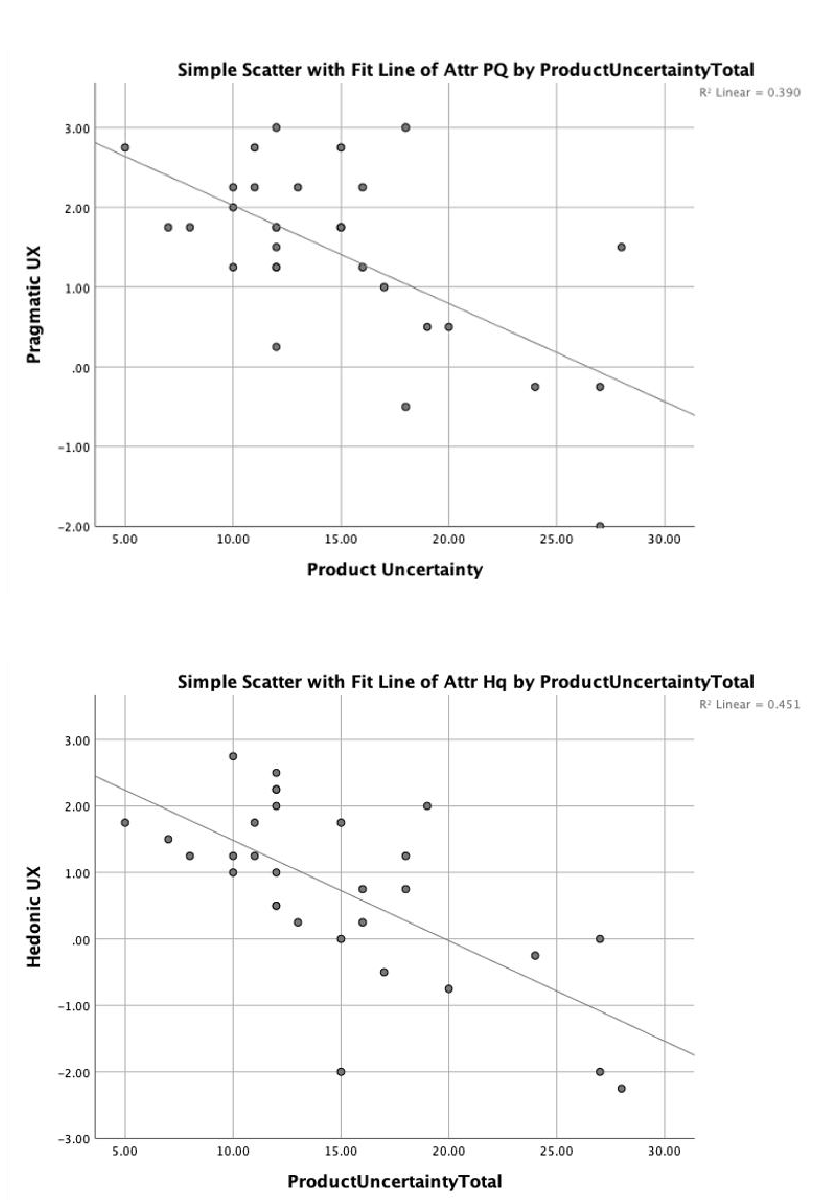
H4: Uncertainty hurts everything. Product uncertainty had a strong negative correlation with both pragmatic UX (rs = -0.51, n = 30, p = .004) and hedonic UX (rs = -0.62, n = 30, p < .001).
What it means
AR is fun, but maybe not useful in e-commerce (yet). AR adds something to the hedonic experience, but it did nothing for the pragmatic side, and it didn't improve mental imagery. On this evidence it's unlikely to be a worthwhile return on investment for most stores.
Customers need a mental picture of the product. How clearly someone can imagine a product, spatially and haptically, affects how uncertain they feel about it.
Product certainty is a key factor in e-commerce UX. Uncertainty has a global effect, lowering both the perceived usefulness and the emotional quality of the experience. The user isn't buying the product. They're buying what they think the product is. If they aren't sure what that is, it won't be a good experience.
The practical takeaway for designers is to stop asking "should we add AR?" and start asking "what would make someone certain about this product?" That might still be 3D or AR. The data suggests the presentation format matters less than whether it helps people form a clear picture.
Limits and next steps
Thirty participants, one product, and iOS only is a small slice, so I'd treat these as a strong signal rather than a settled answer. The follow-up work I'd like to do:
- Different products. Test things with different typical contexts, like furniture or cookware, and at different price points.
- Video. Many retailers now show product video, which should provide more spatial imagery. That's worth measuring.
- In-store comparison. Add a physical product the user can touch as a fourth condition, alongside 2D, 3D and AR.
- A wider sample. More than 30 participants, including Android users.